
Why Rights Matter

A daily, plain-English guide to the rights that already protect every parent and child in the Family Court, and how to use them.
Edition 0, first published 16 October 2026.
A parent walks into a Family Court hearing. They have read the papers twice. They know what they want to say.
What almost nobody tells them is this. Every public body in that room is under a legal duty to respect their human rights, and their child’s. The judge. The Cafcass officer. The local authority social worker. And, outside the courtroom, the police.
That isn’t a slogan. It’s section 6 of the Human Rights Act 1998.
This series is about that duty. One edition a day, one right at a time, in the order they appear in the European Convention on Human Rights. Plain English. Real cases. No jargon you can’t look up.
What human rights are
Human rights are the minimum guarantees a state owes every person within its jurisdiction. They aren’t privileges. They aren’t rewards for good behaviour. They’re guarantees.
In the UK, the main source is the European Convention on Human Rights. British lawyers helped draft it after the Second World War. It was signed in Rome on 4 November 1950, and the UK was the first country to ratify it, on 8 March 1951.
The Convention is a Council of Europe treaty. It has nothing to do with the European Union, and Brexit didn’t change it.
For decades, though, a British parent who wanted to rely on it had to go to the European Court of Human Rights in Strasbourg. That changed on 2 October 2000, when the Human Rights Act 1998 came into force. It brought rights home.
What the Human Rights Act does, in plain English
Four parts of the Act do most of the work.
Section 6: “It is unlawful for a public authority to act in a way which is incompatible with a Convention right.” Section 6(3) says expressly that a court or tribunal is a public authority. So are bodies such as Cafcass, local authorities and the police.
Section 3: legislation must be read and given effect in a way that is compatible with Convention rights, “so far as it is possible to do so”.
Section 2: courts must take into account the case law of the European Court of Human Rights.
Sections 7 and 8: a person whose rights are breached can rely on them in any legal proceedings, or bring a claim, and the court can grant a remedy.
If an Act of Parliament can’t be read compatibly, the higher courts can make a declaration of incompatibility (section 4). Parliament stays sovereign, but the problem goes on the record.
How it applies in the Family Court
The Children Act 1989 makes the child’s welfare the court’s paramount consideration. Human rights law doesn’t override that. It shapes how welfare decisions are made.
The leading example is Re B (Care Proceedings: Appeal) [2013] UKSC 33. The Supreme Court held that an order severing a child’s ties with their birth family must be proportionate under Article 8, and made only where “nothing else will do”. Every less drastic option has to be properly considered first.
The European Court has also made clear that the state’s duty isn’t only to hold back. In Hokkanen v Finland (1994), a father had a court-ordered right of access to his daughter, but the authorities failed for years to enforce it effectively. The Court found that his right to respect for family life had been breached.
Two lessons follow. A court order isn’t the end of the state’s duty. And a child’s relationship with a safe, loving parent is something the law must actively protect, not just acknowledge.
Why it matters for equality, children and policing
Convention rights belong to everyone equally: mothers and fathers, married and unmarried parents, grandparents and children. Article 14 requires them to be secured “without discrimination on any ground such as sex”.
Children are rights-holders in their own right. Where a parent’s interests and a child’s genuinely conflict, the European Court has said the child’s must prevail (Yousef v Netherlands, 2002). That’s right.
But most of the time, a child’s interests and a safe parent’s interests point the same way: towards a relationship that continues.
Rights don’t stop at the courtroom door either. The police are a public authority. So is every local authority children’s service. When anyone reports abuse, the duty to respond fairly and effectively applies whatever the victim’s sex.
And this matters now. Clause 16 of the Courts and Tribunals Bill (Clause 17 during its Commons stages) would remove the Children Act presumption that each parent’s involvement in a child’s life furthers the child’s welfare, unless the contrary is shown. The Bill completed its Commons stages on 13 October and is now before the House of Lords, with Committee stage on 10 and 16 November. Whatever your view of that change, the Convention rights remain. Knowing them is how parents, professionals and Parliament hold the system to the standard it has already signed up to.
What this series will cover
This series covers the rights most relevant to family life: Articles 1, 2, 3, 5, 6, 8, 9, 10, 12 and 14, then the rights to property and education in Protocol 1, and finally an equality right in Protocol 7 that the UK has never signed.
What you can do
Read the source. The Human Rights Act 1998 is free on legislation.gov.uk. Schedule 1 sets out the rights in a few pages.
Ask the question. If a public body makes a decision about your family, you’re entitled to ask how it took your rights, and your child’s, into account.
Raise rights properly. In family proceedings, a party who relies on the Human Rights Act must say so in writing, naming the right and the alleged breach (Family Procedure Rules 2010, rule 29.5). Take legal advice if you can.
Share this with one parent, professional or MP who should know it.
Rights that nobody uses are just words on paper. This series is about making them work.
This series is general information, not legal advice.
Sources
Human Rights Act 1998, ss.2, 3, 4, 6, 7, 8 and Sch 1: https://www.legislation.gov.uk/ukpga/1998/42
European Convention on Human Rights (official text), incl. Art 14: https://www.echr.coe.int/documents/d/echr/convention_ENG
UK ratification deposited 8 March 1951: UK Treaty Series No. 71 (1953): https://treaties.fcdo.gov.uk/data/Library2/pdf/1953-TS0071.pdf
HRA commencement, 2 October 2000: Human Rights Act 1998 (Commencement No. 2) Order 2000, SI 2000/1851
Re B (Care Proceedings: Appeal) [2013] UKSC 33: https://www.bailii.org/uk/cases/UKSC/2013/33.html
Hokkanen v Finland (1994), app. no. 19823/92: https://hudoc.echr.coe.int/eng?i=001-57911
Yousef v Netherlands (2002), app. no. 33711/96: https://hudoc.echr.coe.int/eng?i=001-60723
Family Procedure Rules 2010, r.29.5: https://www.legislation.gov.uk/uksi/2010/2955/rule/29.5
Courts and Tribunals Bill (HL Bill 57), clause 16 (clause 17 in the Commons bill); Commons third reading 13 Oct 2026, Lords first reading 14 Oct 2026, Lords second reading 27 Oct 2026, Lords Committee stage 10 and 16 Nov 2026: https://bills.parliament.uk/bills/4083
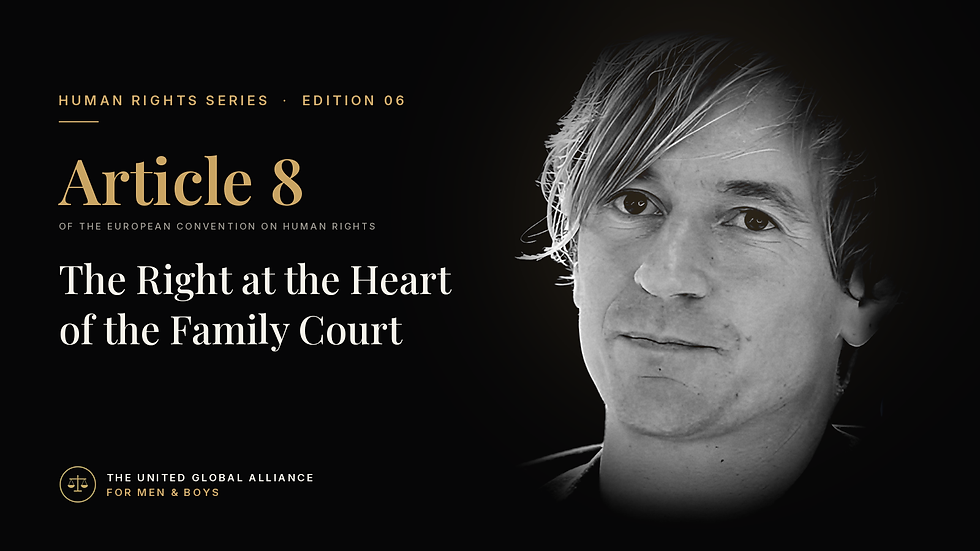
Charley Bickers, Founder of UN For Men - The United Global Alliance For Men & Boys
[Subscribe on Substack button]
The United Global Alliance For Men & Boys is not part of, affiliated with, or endorsed by the United Nations. UN for Men is our campaign for a dedicated UN body for men and boys.


Comments